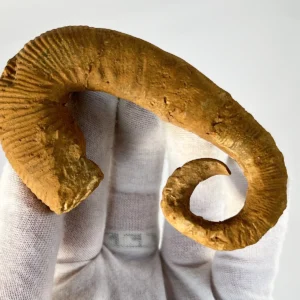
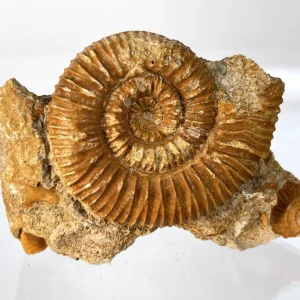
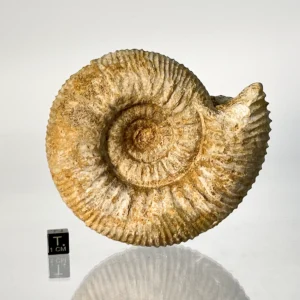
Douvilleiceras Ammonites from Madagascar
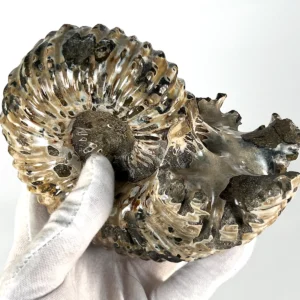
Douvilleiceras is a distinctive genus of ammonite from the Early Cretaceous, best known for its robust shell, strong radial ribbing, and prominent rounded tubercles. These marine cephalopods lived during the Albian Stage, approximately 113–100.5 million years ago, and are among the most visually dramatic ammonites found in Madagascar.
Many Madagascar specimens are especially prized for the preservation of portions of the original shell, including lustrous nacre. Nacre—commonly called mother-of-pearl—is the layered material secreted by the living animal to form the inner portion of its shell. In exceptionally preserved ammonites, some of this original shell material can survive fossilization rather than being completely dissolved or replaced by minerals.
Over millions of years, burial and chemical alteration may modify the nacre’s original structure and appearance, sometimes producing rich iridescent, pearly, bronze, or opalescent surfaces. Even so, the nacre represents preserved material from the actual shell of an animal that lived more than 100 million years ago.
The combination of bold sculptural ornamentation and preserved shell material makes Madagascar Douvilleiceras particularly attractive examples of Cretaceous ammonite preservation.