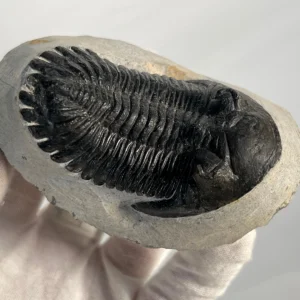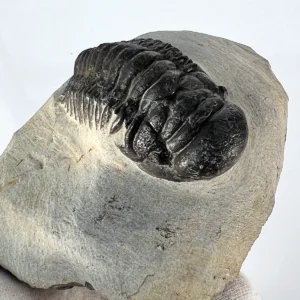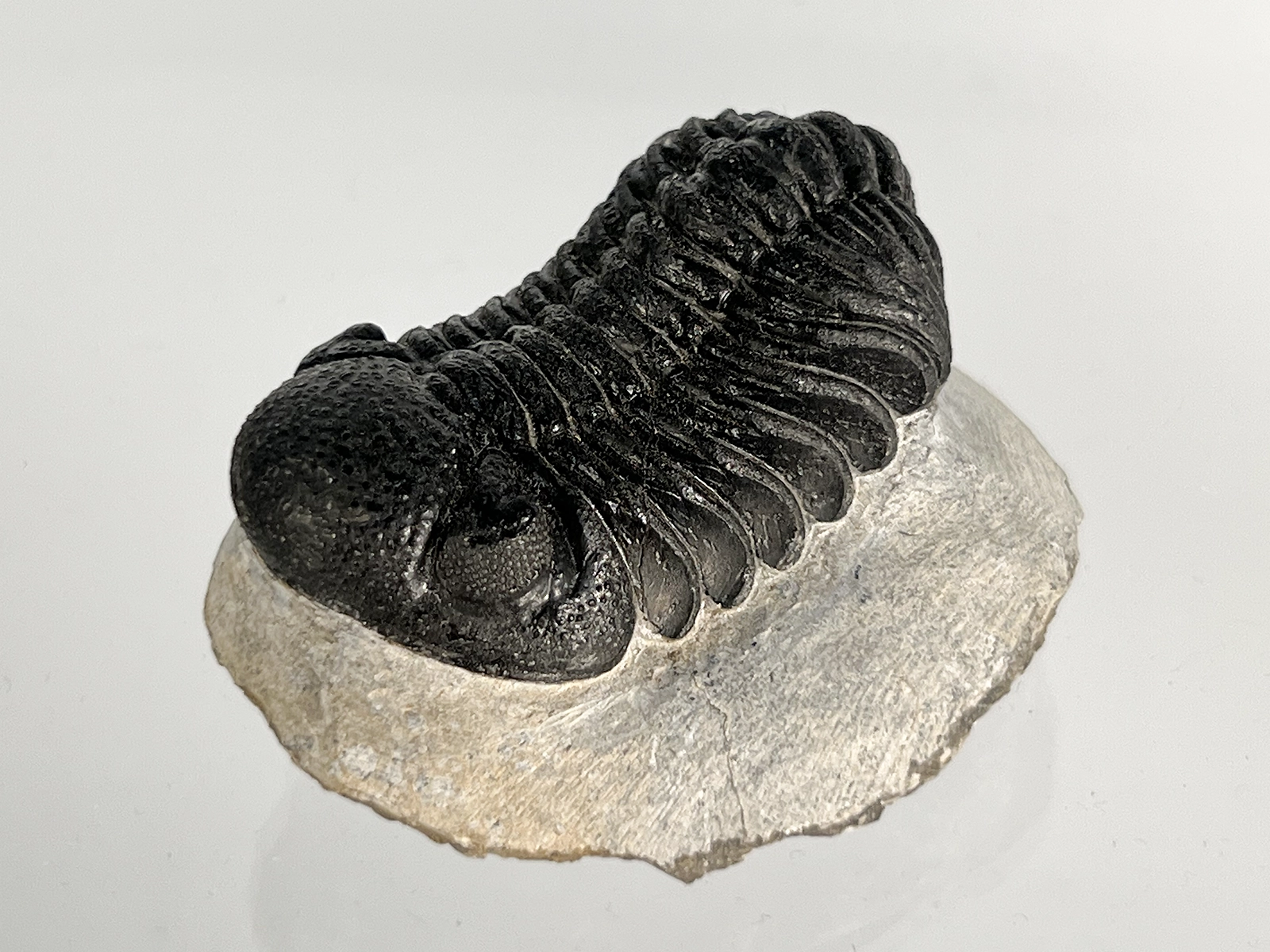
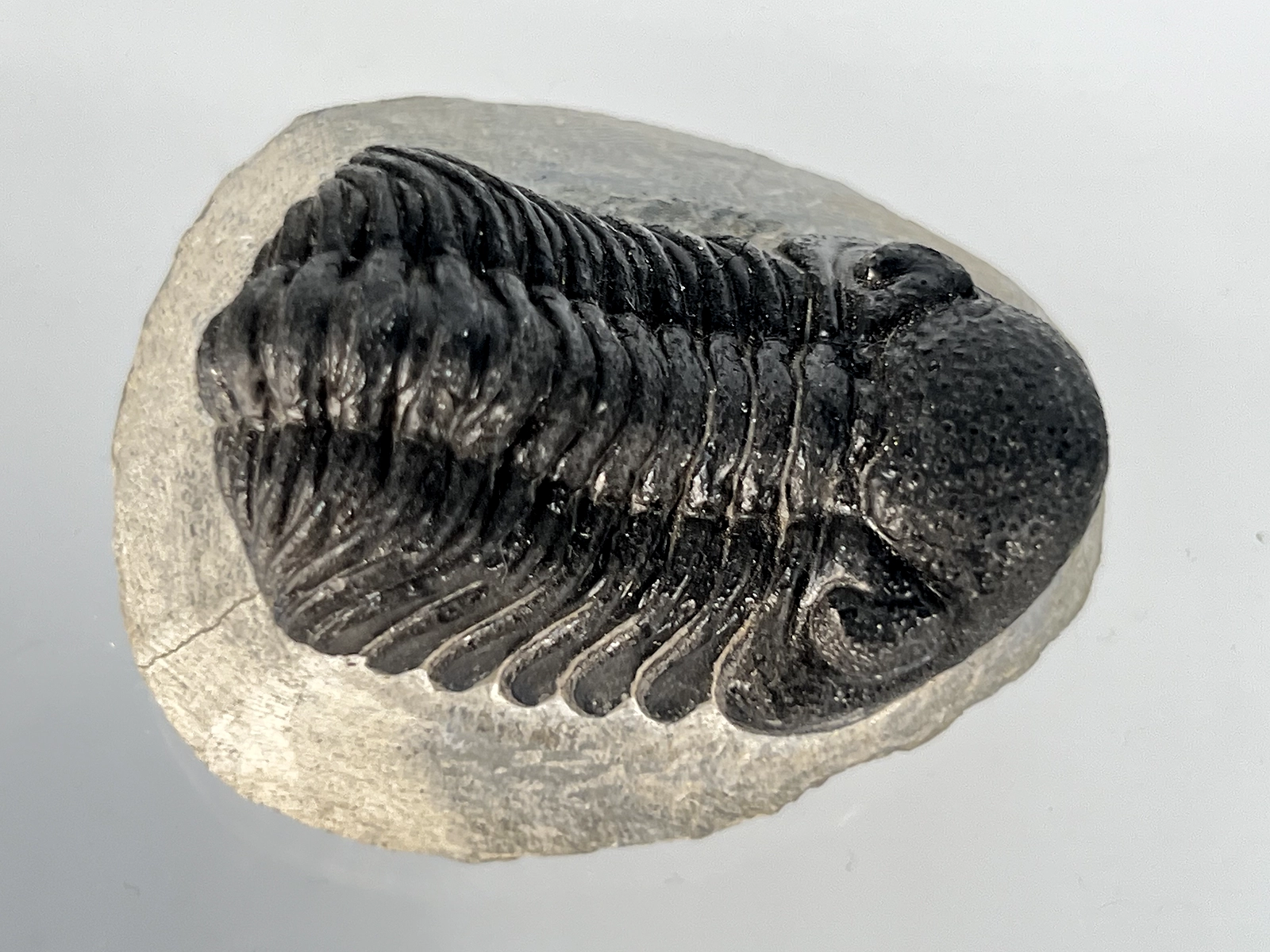
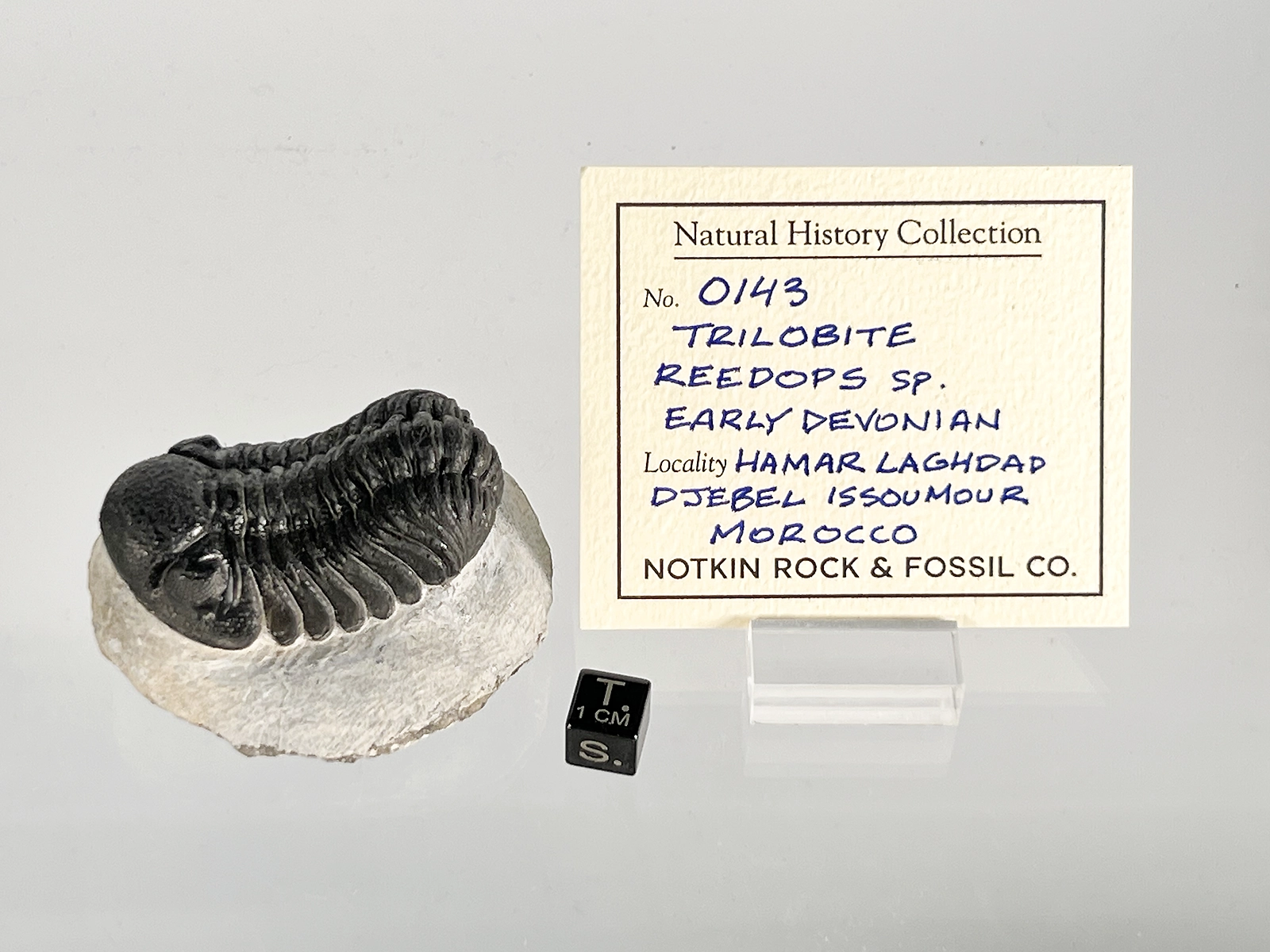
A well-prepared Reedops sp. preserving a complete, articulated trilobite in strong three-dimensional relief against pale limestone matrix. The dark exoskeleton contrasts beautifully with the surrounding rock, while the raised cephalon, segmented thorax, and gently curved posterior give the fossil a particularly lifelike appearance.
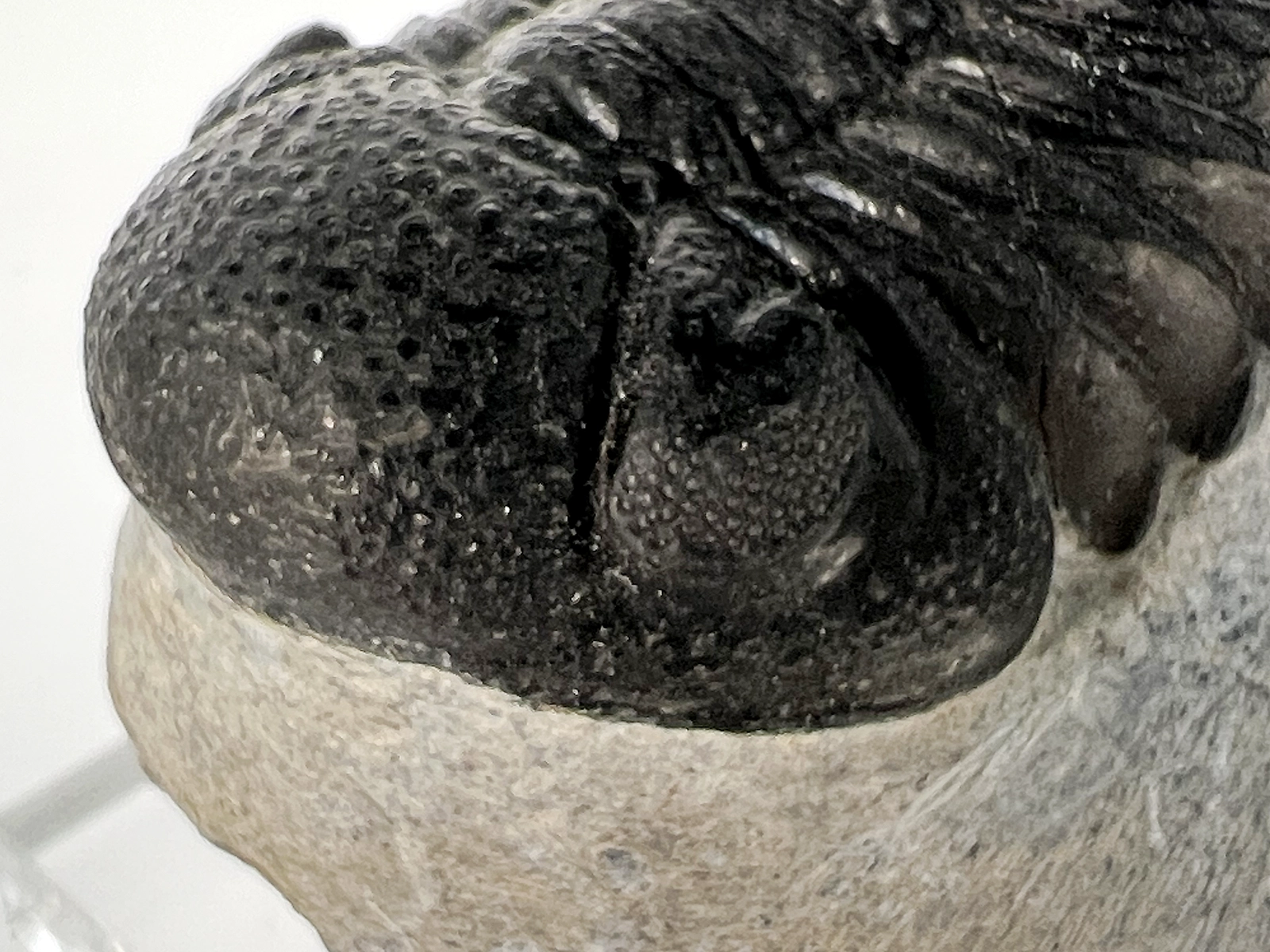
The broad, strongly vaulted glabella is one of the specimen’s most prominent features, and the large schizochroal compound eyes are clearly visible on either side of the head. These specialized eyes, characteristic of phacopid trilobites, were composed of relatively few but unusually large calcite lenses, each functioning as an individual optical element.
The thoracic segments remain sharply defined and continue into the complete posterior portion of the animal. The pygidium is not missing; instead, the rear of the trilobite curves naturally downward over the edge of the matrix, giving the specimen an engaging sense of movement and making its three-dimensional preservation especially apparent.
Reedops was one of the distinctive phacopid trilobites of the Devonian seas. Although superficially similar to the better-known Phacops, Reedops is distinguished by details of the cephalon and, especially, the arrangement of lenses within its compound eyes. Moroccan specimens have historically been sold under a variety of phacopid names, so a conservative identification as Reedops sp. is appropriate without more precise stratigraphic information.
The Hamar Laghdad–Djebel Issoumour region is itself a remarkable fossil locality. During the Devonian, this part of what is now southeastern Morocco lay beneath a tropical sea, and the area preserves an exceptionally diverse marine fauna. Modern studies describe Hamar Laghdad as one of the richest Devonian paleontological localities on the eastern Anti-Atlas, with fossil-bearing rocks spanning a substantial part of the Devonian succession.
There is an especially interesting connection between Reedops and this locality: studies of phacopid trilobites from Hamar Laghdad have shown that some specimens preserve the original calcitic lenses of their eyes even where much of the surrounding exoskeleton was chemically altered during fossilization. In some examples the lenses are even differently colored from the rest of the shell, providing an unusually direct glimpse of the trilobite’s original visual apparatus.
This trilobite also has is particularly meaningful to me. Fairly recently, I visited with a longtime Moroccan friend and colleague who has been in the fossil business since he was a young boy. His father was a well-known prep artist decades ago and my friend happened to mention that he had come across an old box of his father’s work. I asked if I could see it and was amazed by the quality not only of the preparation but of the specimens — collected many years back, before the Moroccan fossil boom. I immediately purchased the entire box and those “old box” specimens have been extremely popular at gem shows. This is one of the last remaining from that collection. I saved some of the best examples for the website!