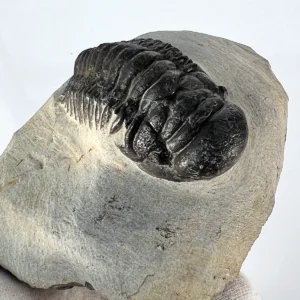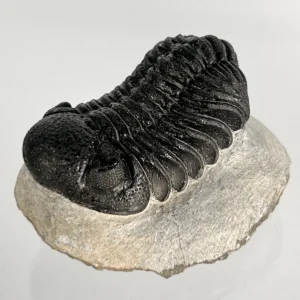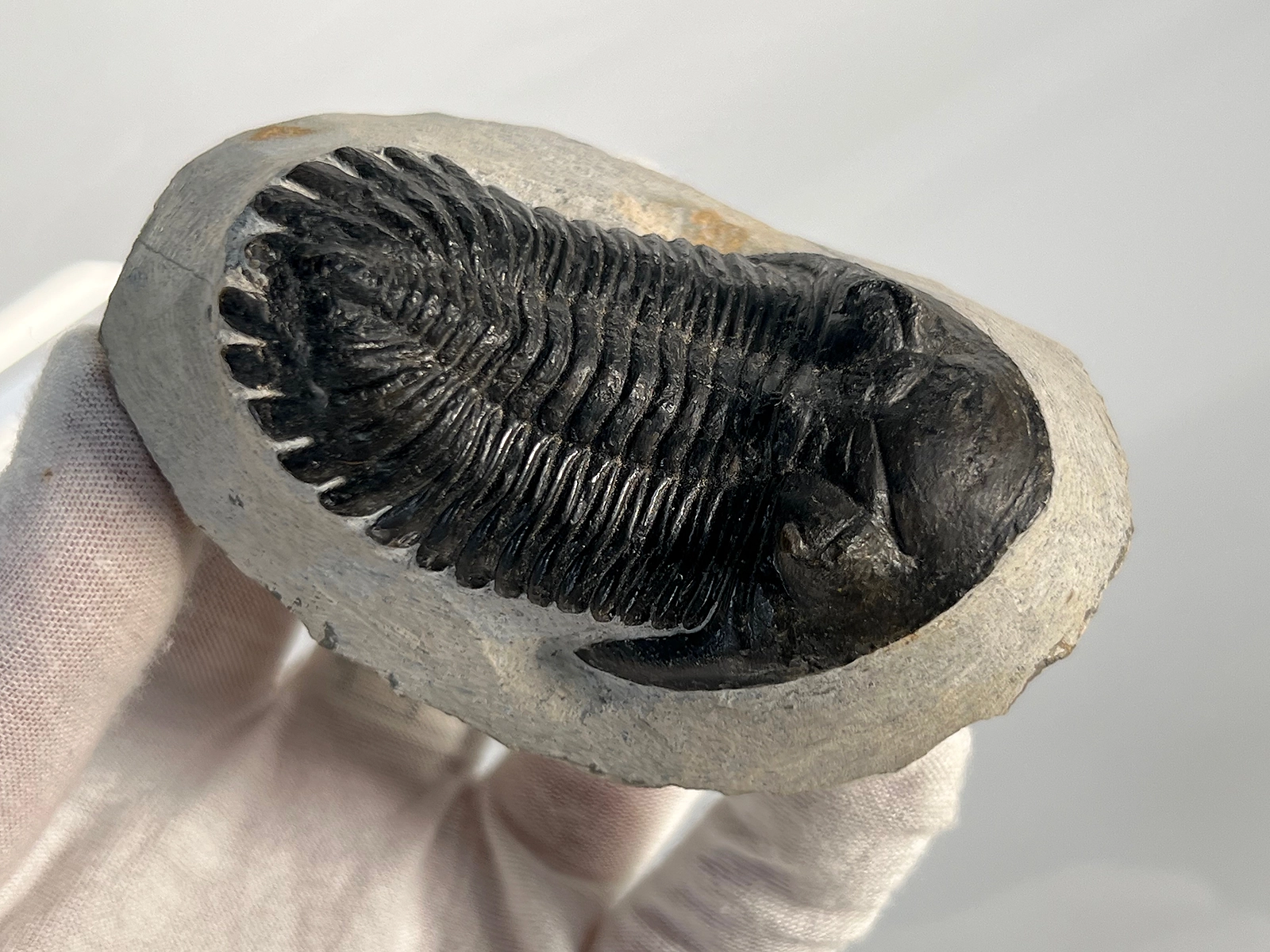
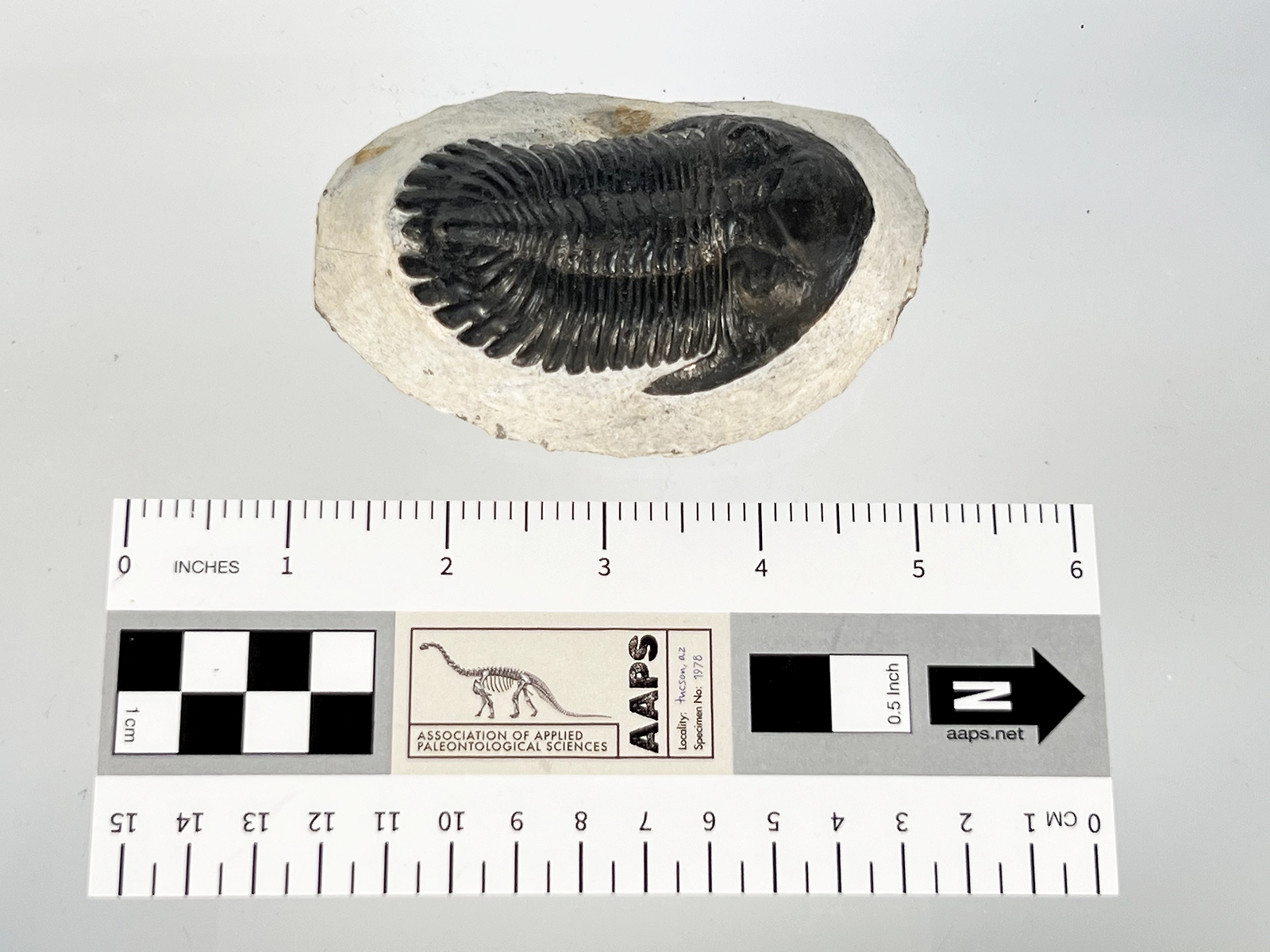
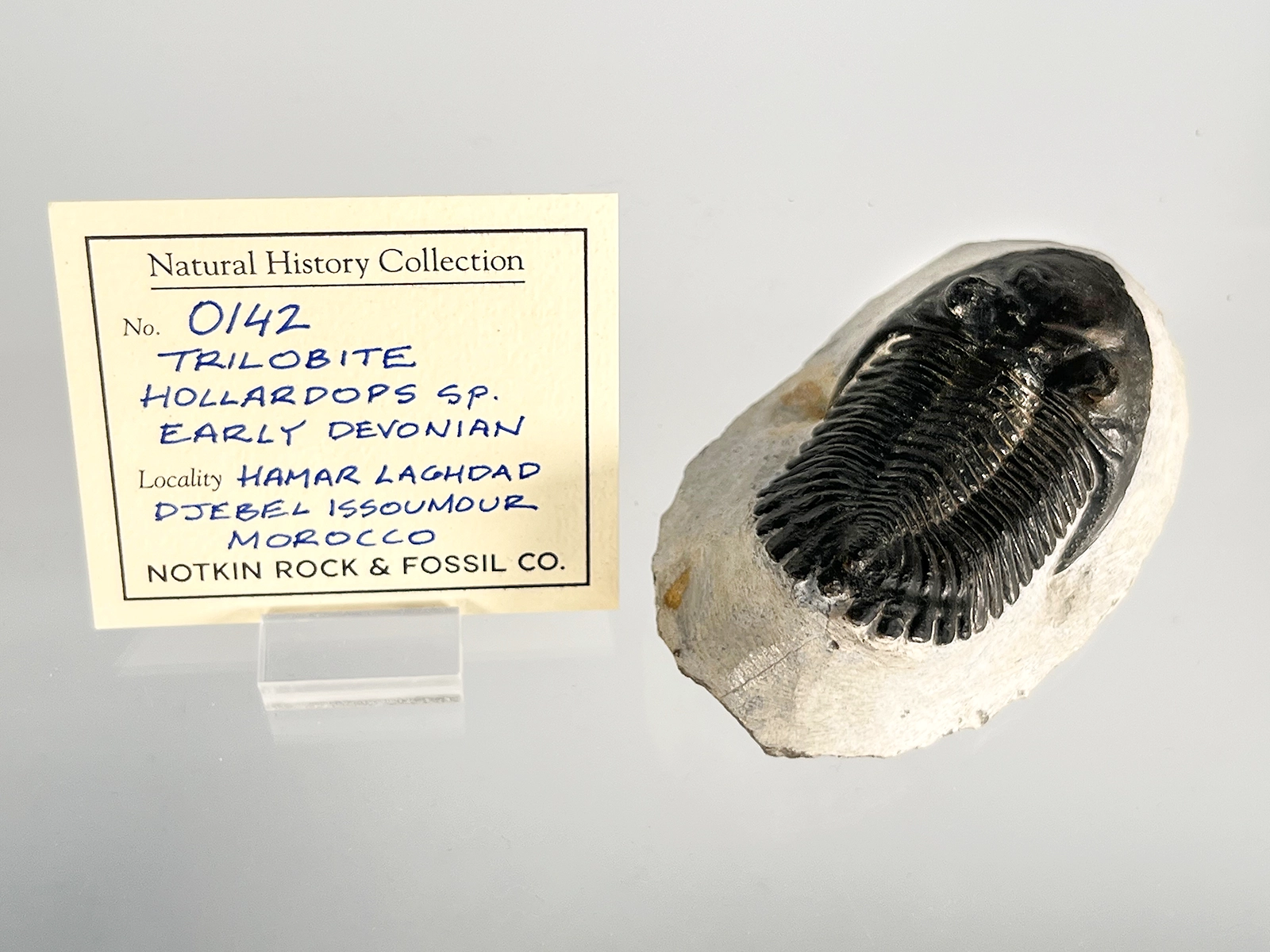
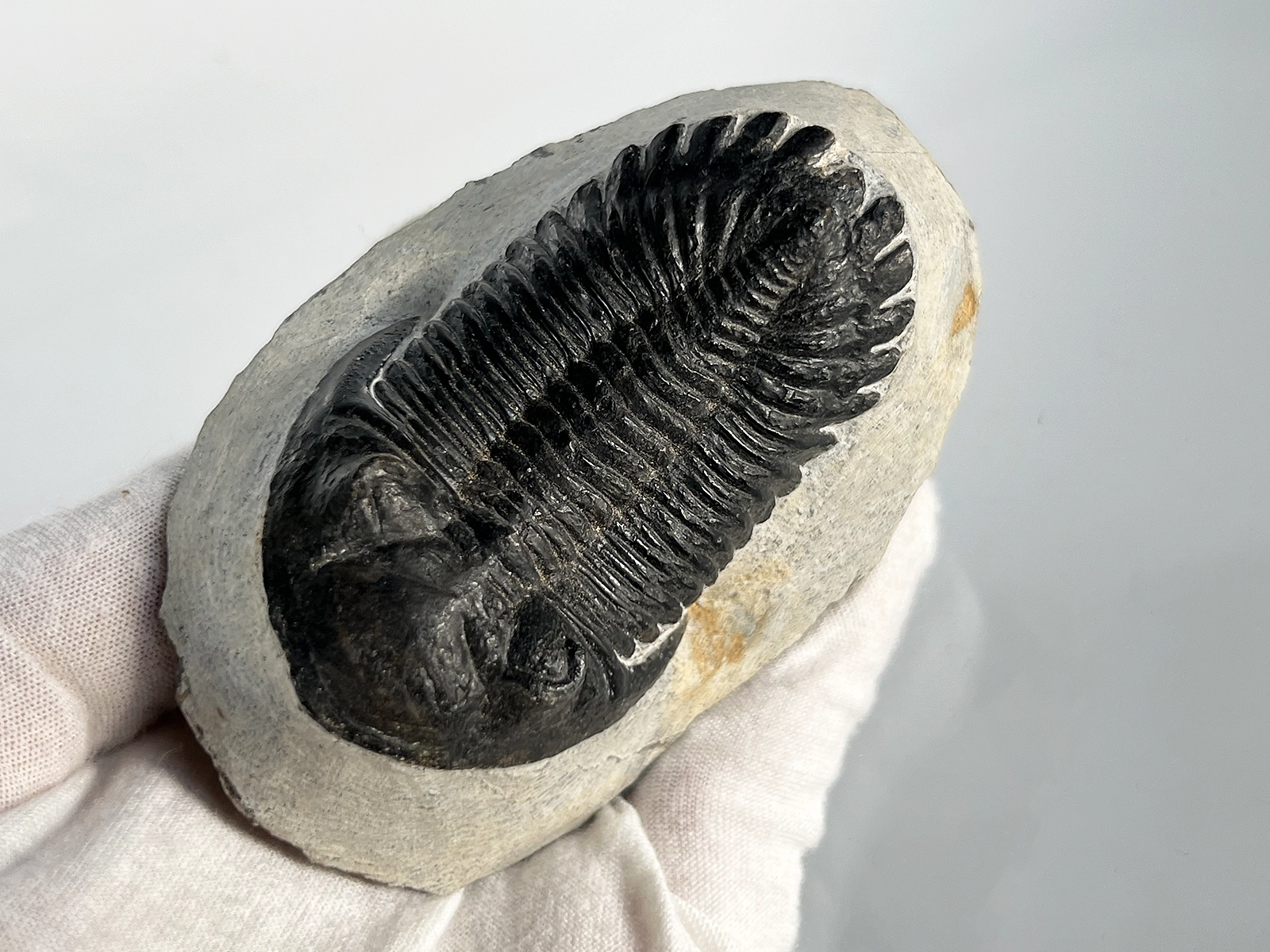
This lovely and unusually large specimen of Hollardops sp. is preserved as a complete, articulated trilobite in pale limestone matrix, with the dark exoskeleton standing out dramatically against the surrounding rock. The specimen has excellent three-dimensional relief, allowing the strongly vaulted cephalon, segmented thorax, and elaborate pygidium to be appreciated particularly well.
Among its most distinctive features are the long, sweeping genal spines projecting backward from the sides of the head. The large compound eyes are also prominently preserved, while the narrow central axis and ten clearly defined thoracic segments give the body an elegant, strongly articulated appearance. At the posterior, the pygidium terminates in a series of broad lateral projections, producing the characteristic scalloped outline seen in Hollardops. Modern study of the genus has shown that its ten-segmented thorax is itself unusual: most closely related asteropygine trilobites possessed eleven thoracic segments.
The preparation has left enough limestone around the fossil to retain a natural field-specimen appearance while exposing the important anatomical features clearly. Seen obliquely, the raised eyes and long genal spines give the trilobite an especially sculptural presence.
Hollardops lived in the shallow seas that covered parts of North Africa during the Devonian. Recent research on exceptionally preserved Moroccan examples has suggested that these trilobites may have been active scavengers or predators, using their well-developed eyes and broad head while searching the seafloor for food. Researchers have even proposed that the unusual structure of the tail may have helped the animal admit oxygenated seawater while partially enrolled — a remarkable example of how seemingly decorative features of a trilobite exoskeleton may also have served a practical biological function.
There is also an interesting modern chapter to the story. Hollardops was formally established as a genus only in 1997, and subsequent work on Moroccan material has shown that the group is more diverse than once believed. Fossils commercially identified for years under only one or two familiar species names actually represent several distinct forms, which is why a conservative identification of Hollardops sp. is preferable for this specimen without precise stratigraphic data.
This Hollardops also has a marvelous personal history. I was visiting with a longtime Moroccan friend and colleague who has been in the fossil business since he was a young boy. His father was a well-known prep artist and my friend happened to mention that he had come across an old box of his father’s work. I asked if I could see it and was amazed by the quality not only of the preparation but of the specimens — collected decades ago, before the Moroccan fossil boom. Every piece was beautiful so, without hesitation, I purchased the entire box. The “old box” specimens have been extremely popular at gem shows, and this is one of the last remaining from the collection. I saved the best ones for the website!